What Is in Batana Oil? The Fatty Acids, Plainly
Ask what is in batana oil and the usual answer is a list of impressive-sounding nouns. A more useful answer is a short one: mostly oleic acid, a good share of saturated fat, and a colourful handful of natural extras. Here is what published analyses of the American oil palm, Elaeis oleifera, actually say, and what it means for how an oil like this feels in your hands.
One fruit, two oils
The first thing worth knowing is that a palm fruit holds two different fats. The fleshy outer pulp, the mesocarp, gives one oil. The seed inside the hard shell, the kernel, gives another. A study that compared both parts in E. oleifera, the African oil palm and their hybrids found that the main fatty acids in the pulp were palmitic, oleic and linoleic, while in the kernel they were lauric, myristic and oleic. In other words, the pulp oil and the kernel oil of a palm are close cousins at best.
That matters because most of the compositional papers are about the pulp, since that is where the commercial palm oil industry looks. Batana oil is described as coming from the nuts, which is the kernel side, and the kernel literature on E. oleifera is thinner. The study above gives a useful pointer: the American palm's lipids carried higher proportions of unsaturated long-chain fatty acids than its African relative, and hybrid kernels resembled their American parent. So the picture below is a fair general portrait of the species. It is not a certificate for any one jar, and individual oils shift with ripeness, region and method.
What oleic-rich means in your palm
Oleic acid is the headline fatty acid, the same one olive oil is known for. Brazilian researchers who analysed fruit oil from five wild American oil palm collections reported oleic acid as the predominant monounsaturated fatty acid in every one. Fats high in oleic acid tend to stay softer and more fluid than fats heavy in saturated ones, which is why olive oil pours and coconut oil sets. In the kitchen sense of the word, an oleic-rich oil feels cushiony and spreads easily.
For skin and hair, we read that as follows, and this is reasoning, not a test result: an oil built on oleic acid is a natural emollient, the kind of ingredient that leaves skin feeling soft and hair feeling smoother and more conditioned. That matches how cosmetic ingredient listings describe it. The industry directory for Elaeis oleifera kernel oil lists its functions as softening and smoothing skin and conditioning hair, leaving it soft, supple and shiny. Saturated fractions, for their part, give an oil body, which is why oils in this family can thicken in a cool room.
Palm kernel oil from the African palm shows how different the kernel side can be: it is dominated by lauric acid, around 45 percent of its fatty acids, with saturated fatty acids at about 80 percent in total. That is a very firm fat. The American palm's kernel leans the other way, towards more unsaturated fatty acids. It is one reason we would not assume "palm kernel oil" and batana oil are the same thing, a point we return to in our guide to telling real batana oil from imitations.
The colourful extras
Tucked in beside the fats is the unsaponifiable fraction, a small portion of natural compounds that did not come from fatty acids. In the palm literature, two groups stand out. Carotenoids are the orange and red pigments, and in American palm fruit oil they reach past 1,500 milligrams per kilogram. Tocols are the vitamin E family, and in hybrid palm oils tocotrienols dominate over tocopherols. The ranges in published tables are wide: total vitamin E in hybrid crude palm oils ran from about 10 to 2,200 milligrams per kilogram depending on the study.
A range that wide is an honest message in itself. These minor ingredients vary with the palm, the fruit and, as we explore in raw vs refined batana oil, with whether the oil was refined, because bleaching and high-temperature deodorizing take pigments out. They add colour and a little character. We would not build a promise on any particular number.
What a composition sheet cannot say
A fatty acid profile describes what an oil is made of. It does not describe what the oil will do for you, and a long tidy table can make the two seem closer than they are. To our knowledge, no published human study has tested batana oil itself on hair or skin; our overview of what batana oil research does and does not show goes through that in detail. What composition does give you is a sensible expectation about texture, feel and how the oil behaves in a cool or warm room. For the practical side of using it in a hair routine, start with batana oil for hair, and for the plant itself, see what batana oil is.
Behind the chemistry is a plain pleasure: an oil built mostly from the same fat that makes olive oil silky, with a little colour and a toasty character, from a palm most people have never heard of.
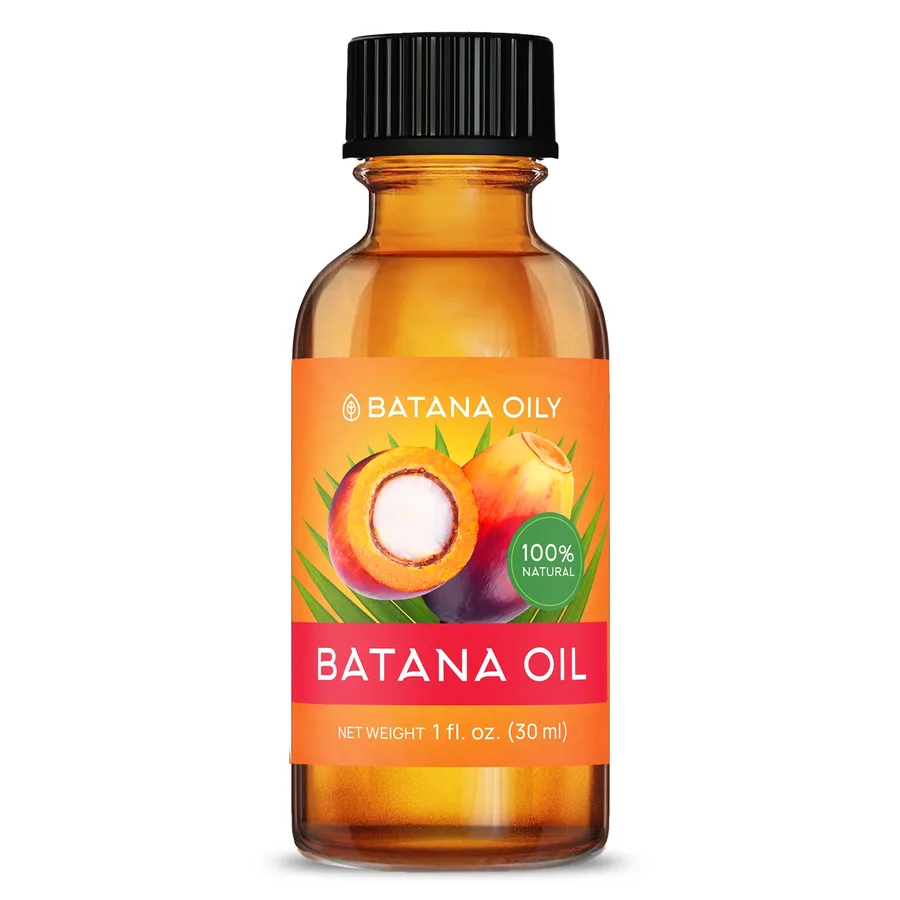
Natural Batana Oil
Honduran batana oil and batana butter, from a small bottle to bulk sizes.
From $12.99
Shop Batana Oil →Sources & Further Reading
- Characterization of Mesocarp and Kernel Lipids from Elaeis guineensis Jacq., Elaeis oleifera [Kunth] Cortés, and Their Interspecific Hybrids. Journal of Agricultural and Food Chemistry (2017). (Pulp versus kernel fatty acids; American palm lipids more unsaturated.)
- Chemical Characterization of the American Oil Palm from the Brazilian Amazon Forest. Crop Science (2018). (Oleic acid predominant; carotenoids above 1,500 mg/kg.)
- Current Knowledge on Interspecific Hybrid Palm Oils as Food and Food Ingredient. Foods 9(5):631 (2020). (Tocols, carotenoids, palm kernel oil composition, effects of refining.)
- COSMILE Europe. ELAEIS OLEIFERA KERNEL OIL – Ingredient. (INCI name, plant part and listed cosmetic functions.)